 Activix
 AutoTrader
 Black Book
 CarGurus
 Equifax
 TransUnion


Most dealerships treat the test drive as the event. A customer walks in, a salesperson grabs keys, and 45 minutes later they come back to the showroom. Then the real work starts: pulling credit, verifying ID, structuring a deal, hoping the buyer qualifies for the vehicle they just drove.
That sequence is backwards. The test drive is more effective when you already know the customer's credit tier and have verified their identity before they turn the key. By the time they return from the drive, the desk manager should already have the deal structured.
The question we hear most from sales managers is: How can car salespeople use test drives more effectively to sell more cars? The answer isn't a better route or a slicker walk-around. It's what happens in the 60 seconds before the drive begins.
In our experience working with 650+ dealerships across North America, there are 4 key factors that separate test drives that close from test drives that waste the afternoon:
1. You know the buyer is real before you hand over the keys.
Fraud risk during test drives is no longer a rare edge case. Identity fraud now accounts for over 75% of fraudulent applications in Canada, and it's up 54% year-over-year. If your sales team is handing over $60,000 of inventory based on a photocopied driver's license, you have a problem that no sales script will fix.
To do that, you need a KYC-compliant ID verification step that runs on the customer's phone before they ever get behind the wheel. Government ID parsing, biometric selfie, and liveness check in under a minute.
2. You know the credit tier before you walk to the lot.
Here's what happens at most stores: a top rep spends 45 minutes on the drive, walks the customer back to the desk, and discovers the buyer is 580 subprime looking at a Prime-only vehicle. That's an hour you don't get back, and a customer who now has to be re-pitched into a different unit.
From our experience, sales managers remember the hour wasted on an unqualified test drive far more than they remember the walk-in who closed. What they want is a soft credit pull that runs before the drive, doesn't impact the customer's score, and tells the desk whether this is a Prime, Near-Prime, or Subprime deal.
A good pre-qualification workflow should return a credit tier, score range, debt load, and buying power in under 60 seconds. Not 7 days. Not a trip to F&I. Before the test drive.
3. The desk manager can structure the deal while the customer is driving.
Now the context gets interesting. What if the sales manager asks: "Can we have payment options ready for this customer before they get back from the drive?"
Most dealerships can't. They export credit data from one system, pull inventory cost from the DMS, cross-reference lender guidelines in a third tab, and manually build a payment grid. That's 20 to 30 minutes of work that happens after the customer returns, while the buyer sits in the showroom losing momentum.
A good credit-qualification platform should structure the deal in parallel with the test drive. By the time the buyer parks the car, the desk should have payment, term, interest rate, and backend profit already calculated on the vehicle they just drove.
4. The whole flow lives in one place, from QR scan to signed deal.
Yes, this post is about test drives. But a good pre-qualification platform should also carry that verified ID and credit data through to the credit application, the lender submission, and the F&I box.
Why? Because the number one way deals die between test drive and signature is friction. Every time your team re-keys data, asks the customer to fill out another form, or waits on a lender callback, the buyer has another chance to walk out.
You might wonder, can't I just use my CRM for that? You can, but a CRM doesn't do credit pulls, biometric ID checks, or lender matching. Stitching five tools together creates data gaps and compliance risk. One unified record from the moment they book the test drive to the moment they sign is faster and safer.
After years of building credit-qualification tech for dealerships that were tired of losing deals at the desk, we built the AVA® Platform. Below is how it maps to the four factors above, with the VeriDrive® → AVA® Credit flow at the center.
Factor 1: Verify the Buyer Before You Hand Over the Keys (VeriDrive® ID Check)
VeriDrive® is the entry point. When a customer books or starts a test drive, they scan a QR code or receive a secure SMS link. The flow runs on their phone and takes under 60 seconds.
Here's what happens on the dealer side. Government ID is captured, parsed, and validated. A biometric selfie confirms the person holding the ID is the person about to drive the vehicle. A liveness check prevents someone from using a photo of a stolen license. All of it posts to the lead record in the AVA® Portal before your sales rep walks out of the showroom.
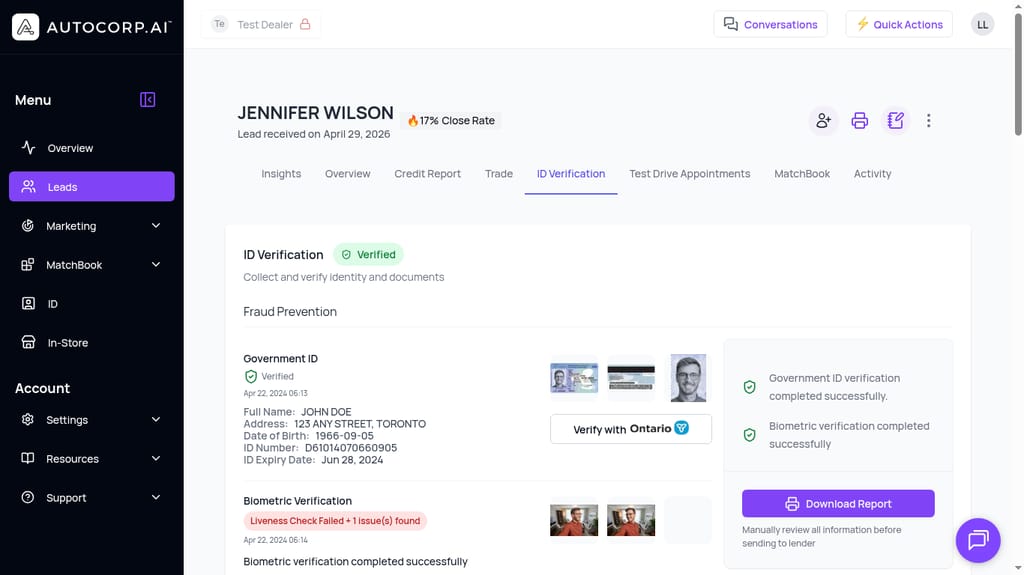
For example, a walk-in asks to drive a 2023 F-150. Instead of photocopying their license at the front desk, your rep hands them a QR code. The customer completes ID verification on their phone in the showroom. Front of ID, back of ID, selfie, done. By the time the rep grabs the keys, the Verified badge is already green in the portal.
That's the simple case. What about the walk-in who seems off? Maybe the ID photo doesn't match. Maybe the liveness check fails. VeriDrive® flags it on the sales desk in real time, which means your rep can politely slow down, ask a follow-up question, or involve a manager before the keys ever leave the cabinet.
For a Sales Manager, this is the difference between a stolen vehicle report and a normal Tuesday. And for the 99% of buyers who are legitimate, the whole thing adds about a minute to the process while removing all the manual photocopy and paperwork your team used to do.
Factor 2: Know the Credit Tier Before the Test Drive Begins (AVA® Credit Soft Pull in 60 Seconds)
AVA® surfaces soft-pull credit, trade equity, and verified ID on every lead. Take the 60-second tour.
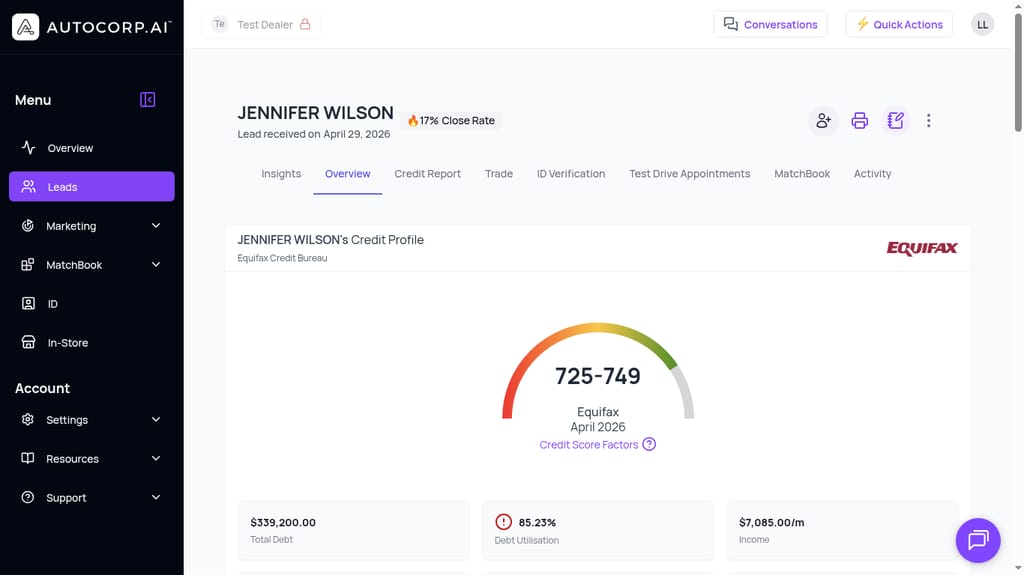
Book a demo →Once ID is verified, the same flow prompts the customer for a soft credit pull powered by Equifax Canada. No impact to their score. The data lands in the lead's Overview tab inside the AVA® Portal, visible to the desk and the sales floor.
Here's what the desk manager sees before the customer even walks to the lot: credit score range, total debt, debt utilization, monthly income, delinquency buckets, and a tier label (Prime, Near-Prime, Subprime).
Say a customer walks in asking about a $55,000 SUV. The soft pull returns a 580 Subprime score with high debt utilization. Your rep now knows two things before the drive: this buyer qualifies, but probably not for the SUV they walked in for. Instead of a 45-minute drive followed by a painful "sorry, financing didn't work" conversation, the rep pivots to a $32,000 unit the buyer can get approved on. Same test drive effort, actual deal at the end.
Or the opposite. The soft pull returns 740 Prime with low debt load. Now your rep knows this is a buyer worth 90 minutes of attention, worth the deluxe demo, worth the GM walking over to say hello.
In our experience, sales managers who adopt soft-pull-before-test-drive see three changes almost immediately:
- Reps stop driving unqualified buyers around the block.
- The desk stops getting ambushed by surprise credit situations.
- Close rates on test drives go up because the vehicle shown matches the buying power.
The old way of doing this, running credit after the drive, is expensive. You've already burned a rep's hour, a tank of gas, and the customer's goodwill if the numbers don't work. The AVA® Credit soft pull moves that decision 60 seconds before the drive instead of 45 minutes after.
Factor 3: Have the Deal Structured by the Time They Return (AVA® MatchBook, All Inside the Portal)
Most dealers are fine with knowing the credit tier before the drive. That alone is a step change.
But what if your GM asks a harder question: "Can we have three vehicle options with full payment grids ready when the customer walks back in?"
That would normally require pulling the lender guidelines, exporting inventory from the DMS, calculating payments by hand for each unit, and then printing a sheet. By the time the deal structure is ready, the customer has been sitting in a sales office for 20 minutes losing excitement.
With AVA® MatchBook, the deal gets structured while the customer is driving. The way MatchBook works is simple. Credit tier, trade equity, and lender approvals come in from AVA® Credit and AVA® Trade. MatchBook cross-references them against your live inventory and returns a ranked list of vehicles the customer can actually get approved on, with payment, term, interest rate, frontend profit, reserve, and estimated backend available for each unit.
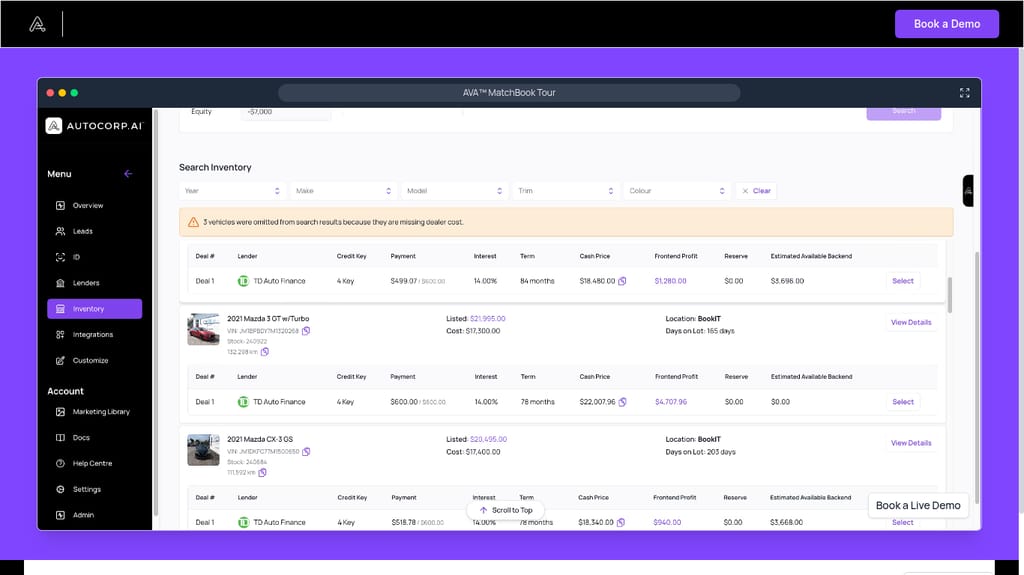
Say the buyer is out driving a 2021 Mazda 3 GT. While they're on the route, the desk pulls up MatchBook and sees that same vehicle structured at $499.07/month over 84 months with TD Auto Finance, 14% interest, $1,280 frontend profit, $3,696 estimated backend. They can also see two comparable units on the lot in case the buyer hesitates on the Mazda.
When the customer parks the car, the desk manager doesn't say "give us a minute to run some numbers." They say "based on your Equifax tier, here's what the Mazda looks like at $499 a month, and here are two other options if you want to compare." The buyer went from test drive to deal structure with zero waiting room time.
For a Sales Manager, this is where the compounding happens. A buyer whose mindset shifted from "should I buy this?" to "I don't want to miss out" during the drive now gets numbers on the spot while that emotion is still fresh. The window between emotional peak and signed paperwork collapses from hours to minutes.
Note: MatchBook deal structures update as new lender approvals come in, so if your F&I team adds a captive lender mid-afternoon, the deal grid refreshes automatically.
Factor 4: Carry the Verified Record All the Way to Signature (AVA® Co-Driver, Without Switching Tools)
Yes, you came here to learn how to sell more cars with a test drive.
But as we mentioned up top, a good credit-qualification platform should also carry the verified ID, credit, and deal structure forward into the credit application, the lender submission, and the F&I box, without your team re-keying anything.
Why? Because the test drive is the emotional moment, but the deal dies in the paperwork. Every tool switch is a chance for the buyer to cool off.
Now you may wonder, can't I just copy the data from the portal into my desking software? Yes, you can, but every manual copy is another chance for a typo, a stale number, or a compliance miss. And when a lender flags a discrepancy between the ID on file and the credit app, you're starting over.
AVA® Co-Driver is a browser extension that surfaces the verified customer profile inside your existing desking and finance software. The desk manager sees the Equifax tier, VeriDrive® ID verification status, trade equity, and MatchBook payment grid in the same browser tab where they build the deal.
The practical outcome: the buyer who scanned a QR code 90 minutes ago to book a test drive now signs paperwork pre-filled with their verified data. No clipboard. No re-typing. No "can we see your license again?" Just a buyer who feels like your dealership has its act together, which is a feeling most customers have not had buying a car.
For a Sales Manager running a 20 to 100 person dealership, this is the part that moves the operational metrics. Average time from test drive to signed deal drops. Fraud chargebacks drop. Rep productivity goes up because the people on your floor are spending time on qualified buyers instead of chasing paperwork.
See the VeriDrive® → AVA® Credit Flow in Action
The test drive isn't the moment that sells the car. It's the moment that confirms what the pre-qualification already decided. If you want your sales team to spend their energy on buyers who can actually buy, with deals already structured by the time they park the car, the 60-second qualification flow is where to start.
Book a demo of VeriDrive® and the AVA® Platform to see how it fits into your current sales process, or learn more about how credit-qualified leads outperform traditional internet leads by 5 to 7x.


