 Activix
 AutoTrader
 Black Book
 CarGurus
 Equifax
 TransUnion


Most privacy advice for dealerships stops at "update your policy and train your staff." That worked when a credit application was a paper form in a filing cabinet. It does not hold up in 2026, when a single lead touches your website, a credit bureau, a biometric vendor, an SMS platform, a CRM, and three lenders before anyone shakes a hand.
The regulatory pressure is specific. Quebec's Law 25 carries penalties up to $25 million or 4% of worldwide turnover and requires 72-hour breach notification. CASL penalties reach $10 million per violation, and consent is channel-specific (email consent does not cover SMS). The FTC's amended Safeguards Rule has required U.S. dealers to report certain data breaches since May 2024. PIPEDA requires 24-month breach record retention for every incident.
The question is no longer "do we have a privacy policy?" It is "can we prove, lead by lead, that we had consent, verified identity, and controlled who saw what?"
A compliant 2026 workflow needs three things, and AVA® by Autocorp.ai was built around them:
- No-SIN, soft-pull credit qualification with consent captured at the source (AVA® Credit)
- Digital, biometric ID verification that keeps licence images off email, including for test drives (AVA® ID and AVA® VeriDrive)
- Consent-managed SMS with per-message audit trails (AVA® Campaigns)
AVA® VeriDrive: Fraud-Proof Test Drives With a Defensible Identity Record
Test drives are the single weakest point for identity controls in a dealership. Someone walks in, hands over a photocopied licence, and drives off in a $60,000 vehicle. Identity fraud now accounts for over 75% of fraudulent applications in Canada and has risen 54% year-over-year. The test-drive handoff is where a lot of that fraud starts.
AVA® VeriDrive closes that gap by requiring digital ID verification before a test-drive appointment is confirmed. The customer gets a secure link, uploads front and back of their government ID, and completes a liveness selfie. The system parses the document, runs a biometric match, and only then does the appointment move to confirmed.
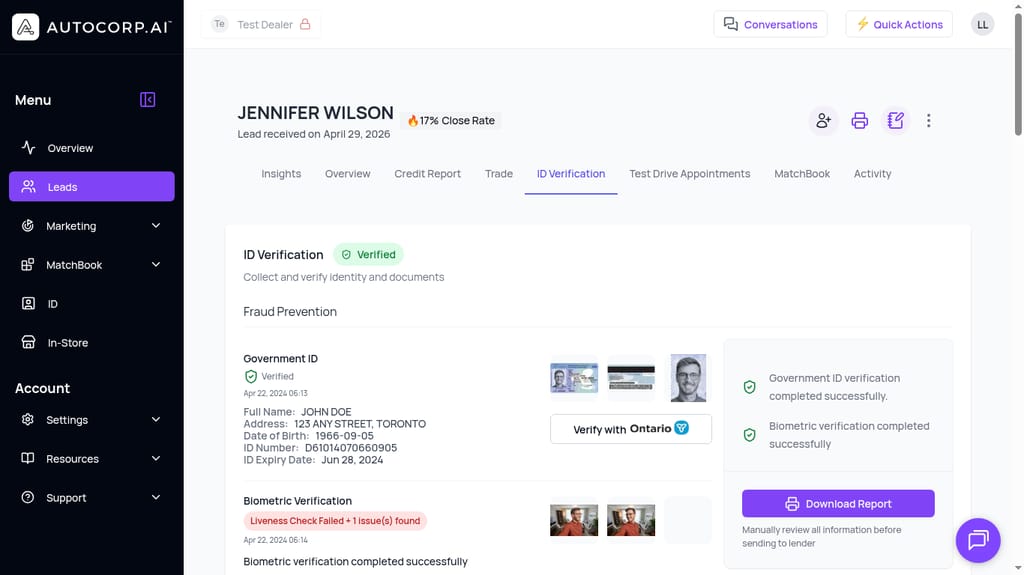
Parsed fields instead of raw images in your inbox. Staff see structured data on the ID Verification tab: Full Name, Address, Date of Birth, ID Number, ID Expiry Date, timestamps, and a checklist of successful checks. The underlying document images stay inside the platform, not attached to a CRM note or a text thread between salespeople.
Provincial integrations where regulators expect them. For Ontario leads, a "Verify with Ontario" button runs the ID against the provincial source of truth. The ID module logs exactly what was checked (Biometric, Driver's License, Credit Bureau), giving you a clean audit record.
A review step before anything leaves the dealership. The ID Verification view includes a "Download Report" button with the subtext "Manually review all information before sending to lender." A small UI detail with a real compliance consequence: the system nudges staff to review before sharing, instead of auto-forwarding sensitive data.
The result is two things regulators and insurers increasingly ask for: proof you verified the driver before handing over keys, and no stray licence photos floating around personal phones.
AVA® Credit: No-SIN Soft Pulls With Consent at the Source
Most dealership credit workflows still ask for a SIN "just in case the lender needs it," collect it on a paper form, and store it somewhere no one has inventoried. Under PIPEDA and Law 25, that is unnecessary data collection, unclear purpose, and weak retention controls, all in one.
AVA® Credit uses a four-step bilingual form (English and Français, which matters for Law 25) that opens with "Get Your Free Equifax® Credit Snapshot. No impact to your score." The customer sees the purpose, the bureau, and the no-impact nature of the request before typing anything. No SIN is collected for the soft pull, which removes the highest-sensitivity data point from the top of the funnel.
AVA® checks government ID, matches a live selfie, and runs 30+ fraud checks in about 60 seconds. See it live.
Book a demo →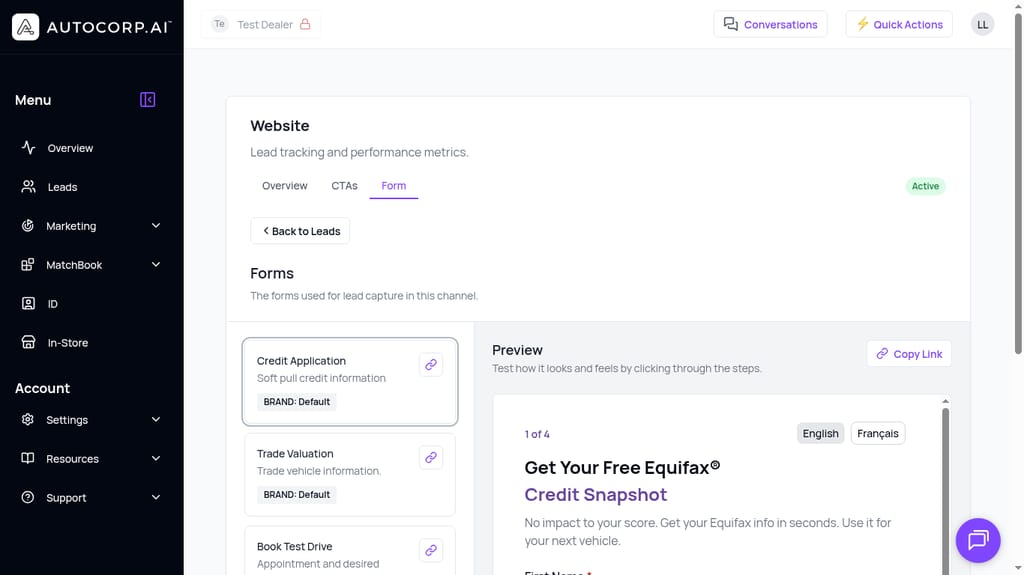
Staff do not email credit files or save them to a desktop. The customer completes the Equifax verification through a tokenized link, and the bureau data lands inside the lead record with a timestamp. Credit scores appear in the Leads list as bureau ranges (for example, 725–749), while full report detail sits one tab deeper where F&I needs it. Sales can qualify a lead without ever seeing the raw pull, which satisfies the need-to-know principle regulators expect dealers to demonstrate.
AVA® Campaigns: Consent-Managed SMS With a Per-Message Audit Trail
CASL treats SMS consent as separate from email consent. If a customer opted in to your email newsletter, that does not give you the right to text them. Dealers get in trouble when their SMS tool has no awareness of how, when, or on what channel the customer agreed.
AVA® Campaigns ties every text thread to the campaign and lead that generated it. In the Conversations hub, each conversation shows the contact, the channel, and a campaign badge (for example, "Campaign Apr 23 2026 9:02:34 pm"). That is the audit trail a regulator or complaint response needs: who was contacted, on which channel, from which campaign, at which timestamp.
STOP replies actually stop future sends on that channel, and every lead has a Source field that lets you trace a text back to the original opt-in moment. This matters because CASL's implied consent window is only 6 months from an inquiry (24 months from a transaction). After that, you need to prove express consent, and the trail needs to be in the system.
The Operational Layer
Technology removes most recurring risks, but a few obligations stay with your team.
Set a written retention schedule for credit files, ID verifications, and SMS threads. "We keep it forever" is no longer defensible under PIPEDA or Law 25.
Review consent language quarterly. Walk through the AVA® pre-qualification form, the Campaigns opt-in, and the VeriDrive link once a quarter. Confirm what you say matches what you do.
Train to roles, not to generic slide decks. Sales needs to know how to send a soft pull and a VeriDrive link without ever handling raw bureau data. F&I needs the lender-sharing path.
Be ready to report a breach. Quebec requires 72-hour notification. The FTC Safeguards Rule has specific reporting thresholds in effect since May 2024. Know who makes the call and where the audit trail lives (it lives in the lead record). Autocorp.ai is a member of the Digital Identification and Authentication Council of Canada (DIACC), which gives you a useful anchor for vendor due-diligence conversations.
The 2026 Bottom Line
The dealers who struggle in 2026 will run a 2019 workflow (paper credit apps, emailed licence photos, ad-hoc SMS blasts, handshake test drives) against 2026 enforcement. The ones who win will capture consent at the moment of collection, verify identity digitally before keys change hands, and keep SMS opt-ins clean per channel.
If you want to see how AVA® Credit, AVA® ID, AVA® VeriDrive, and AVA® Campaigns fit against your current process, book a demo with Autocorp.ai. We will walk through your real customer flow and show you where the data lives at every step.


